plugin

Description

Quote:

The Pairwise Stitching first queries for two input images that you intend to stitch. They can contain rectangular ROIs which limit the search to those areas, however, the full images will be stitched together. Once you selected the input images it will show the actual dialog for the Pairwise Stitching.

has function
need a thumbnail
Description

napari-lattice is a napari plugin designed for the analysis and visualization of Lattice Lightsheet Microscopy (LLSM) and Oblique Plane Microscopy (OPM) data, particularly focusing on data acquired from Zeiss Lattice Lightsheet systems. Also available as lls-core - a command line version of the same tool which does not require napari.

napari-lattice allows users to deskew and deconlolve lattice light sheet, or any oblique plane microscopy, data. To speed processing, users can provide ROIs to be cropped and processed separately.  This significantly speeds up processing time and allows many options for parallelisation. 

Description

NODeJ is an ImageJ plugin for 3D segmentation of nuclear objects.

"The three-dimensional nuclear arrangement of chromatin impacts many cellular processes operating at the DNA level in animal and plant systems. Chromatin organization is a dynamic process that can be affected by biotic and abiotic stresses. Three-dimensional imaging technology allows to follow these dynamic changes, but only a few semi-automated processing methods currently exist for quantitative analysis of the 3D chromatin organization. We present an automated method, Nuclear Object DetectionJ (NODeJ), developed as an imageJ plugin. This program segments and analyzes high intensity domains in nuclei from 3D images. NODeJ performs a Laplacian convolution on the mask of a nucleus to enhance the contrast of intra-nuclear objects and allow their detection. We reanalyzed public datasets and determined that NODeJ is able to accurately identify heterochromatin domains from a diverse set of Arabidopsis thaliana nuclei stained with DAPI or Hoechst. NODeJ is also able to detect signals in nuclei from DNA FISH experiments, allowing for the analysis of specific targets of interest. NODeJ allows for efficient automated analysis of subnuclear structures by avoiding the semi-automated steps, resulting in reduced processing time and analytical bias. NODeJ is written in Java and provided as an ImageJ plugin with a command line option to perform more high-throughput analyses. NODeJ can be downloaded from https://gitlab.com/axpoulet/image2danalysis/-/releases with source code, documentation and further information avaliable at https://gitlab.com/axpoulet/image2danalysis . The images used in this study are publicly available at https://www.brookes.ac.uk/indepth/images/ and https://doi-org.osaka-u.idm.oclc.org/10.15454/1HSOIE ."

has function
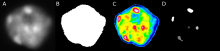
A DAPI-stained nucleus at left, followed by a white segmentation mask, a false-color heatmap, and segmented heterochromatin blocks.
Description

BraiAn is an open-source suite of tools designed to simplify signal quantification, analysis and visualization of large datasets typically obtained in whole-brain imaging experiments, following registration to an atlas. 

The package consists of two separate modules.

  1. BrainAnDetect: A QuPath extension for multi-channel cell segmentation across large and variable datasets. It leverages QuPath's built in algorithms for cell detection, and features additional options for refining signal quantification, including machine-learning-based object classification, region-specific cell segmentation, multiple marker co-expression analysis, and an interface for selective exclusion of damaged tissue portions.
  2. BraiAnalyse: A modular Python library for the easy navigation, visualization, and analysis of whole-brain quantification outputs.
has topic
need a thumbnail
Description

A generalist framework for multi-dimensional automatic spot detection and quantification.

SpotMAX is designed to accomplish two tasks:

  1. Detecting and quantifying globular-like structures (a.k.a. "spots")
  2. Segmenting and quantifying fluorescently labelled structures

It supports 2D, 3D, 4D, and 5D data, i.e., z-stacks, timelapse, and multiple fluorescence channels (and combinations thereof).

has function
SpotMAX Logo