multi-channel

Description

BioImage.IO -- a collaborative effort to bring AI models to the bioimaging community. 

  • Integrated with Fiji, ilastik, ImJoy and more
  • Try model instantly with BioEngine
  • Contribute your models via Github

This is a database of pretrained deep Learning models. 

need a thumbnail
Description

Yet another pixel classifier Yapic is a deep learning tool to :

train your own filter to enhance the structure of your choice 

train multiple filter at once 

it is based on the u-net convolutional filter . 

To train it : annotation can come from example from Ilastik software , tif labelled files can be transferred to yapic. 

Training takes about hours to days , prediction takes seconds once trained .

It can be ran from command line .

note that only 10 to 20 images with sparse labeling are required for efficient training 

has function
need a thumbnail
Description

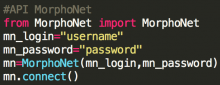
The Morphonet Python API provide an easy interface to interact directly with the MorphoNet server. Very useful to upload, download your dataset and superimpose on it any quantitative and quantitative informations.

Description

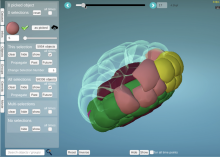
MorphoNet is a novel concept of web-based morphodynamic browser to visualise and interact with complex datasets, with applications in research and teaching. 

MorphoNet offers a comprehensive palette of interactions to explore the structure, dynamics and variability of biological shapes and its connection to genetic expressions. 

By handling a broad range of natural or simulated morphological data, it fills a gap which has until now limited the quantitative understanding of morphodynamics and its genetic underpinnings by contributing to the creation of ever-growing morphological atlases.

Description

VAST (Volume Annotation and Segmentation Tool) is a utility application for manual annotation of large EM stacks.

General labeling tool, used for a large variety of 3D data sets; electron-microscopic, multi-channel light-microscopic, and Micro-CT data sets as well as videos, and annotating arbitrary structures, regions and locations, depending on the user’s needs.