Manual

Description

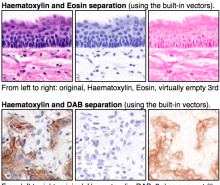
[no download link, this description itself explains the steps to quantify staining in tissue sections] The Color Deconvolution plugin for ImageJ can be used to digitally separate up to three stains from brightfield images, after which standard ImageJ commands can be used. The algorithm is described in Ruifork and Johnston (2001). **However**, it is **very** important to take into consideration the caveats on the linked URL. In particular, note that: - Stain colors depend on numerous factors, such as the precise stains and scanner; therefore, the 'default' stain vectors (used to define the colors) are unlikely to be optimal and may be very inaccurate. See the URL instructions for how to create new stain vectors. - Pixel values should be interpreted with extreme caution; in particular, note the warning regarding 'brown' staining that *attempting to quantify DAB intensity using this plugin is not a good idea*. Note, the pixel values provided by this plugin are 8-bit and **not** equivalent to 'optical densities' frequently presented in the literature. Color deconvolution is particularly helpful in separating stains so that stained regions can be detected (e.g. by setting a threshold), and then the number or areas of stained structures may be quantified. Two potential approaches would be: 1. If one measurement should be made for the entire image: - *Image > Adjust > Threshold...* - *Edit > Selection > Create Selection* - *Analyze > Measure* 2. If distinct structures should be measured: - *Image > Adjust > Threshold...* - *Analyze > Analyze Particles...*

has topic
has function
Description

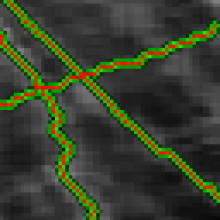
Generation of Kymographs using 2D+t images. In the generated kymographs, objects can be tracked and the results are visualized.

has function
Description

A commercial image analysis software. It's interface allows to easily perform measurements and image analysis. Your actions can be recorded and a macro (in a basic script language) can then be created. Almost no knowledge in programming is needed. You can also use python. A SDK is also available to develop stand alone applications in c++. Additional modules allow to use specific operations (3D operators... Examples of available categories of operators : filtering, edge detection, mathematical morphology, segmentation, Frequency operations, mathematical/logical operations, measurements...

need a thumbnail
Description

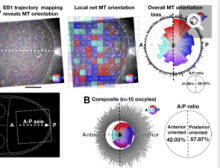
Microtubule end tracking in live cell fluorescent images of Drosophila oocyte involves overcoming the following challenges, which can be tackled by a series of preprocessing steps and tracking described in Parton et al (2011)

  • illumination flicker & photobleaching: suppress by normalising intensities, e.g. using Image->Adjust->Bleach Correction in Fiji/ImageJ
  • uneven illumination: Fourier bandpass filtering (e.g. Process->FFT->Bandpass Filter) preserves features within a selected size range
  • high background / poor contrast: foreground filter, e.g. Temporal Median filter
  • tracking: e.g. TrackMate in Fiji/ImageJ (segmentation using DoG detector)
has function
Description

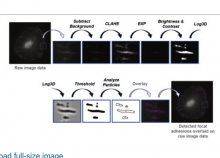
Simple workflow description for ImageJ, step-by-step description for delineating focal adhesions, count and characterize their positions.  

Measurement of dynamics is not involved.